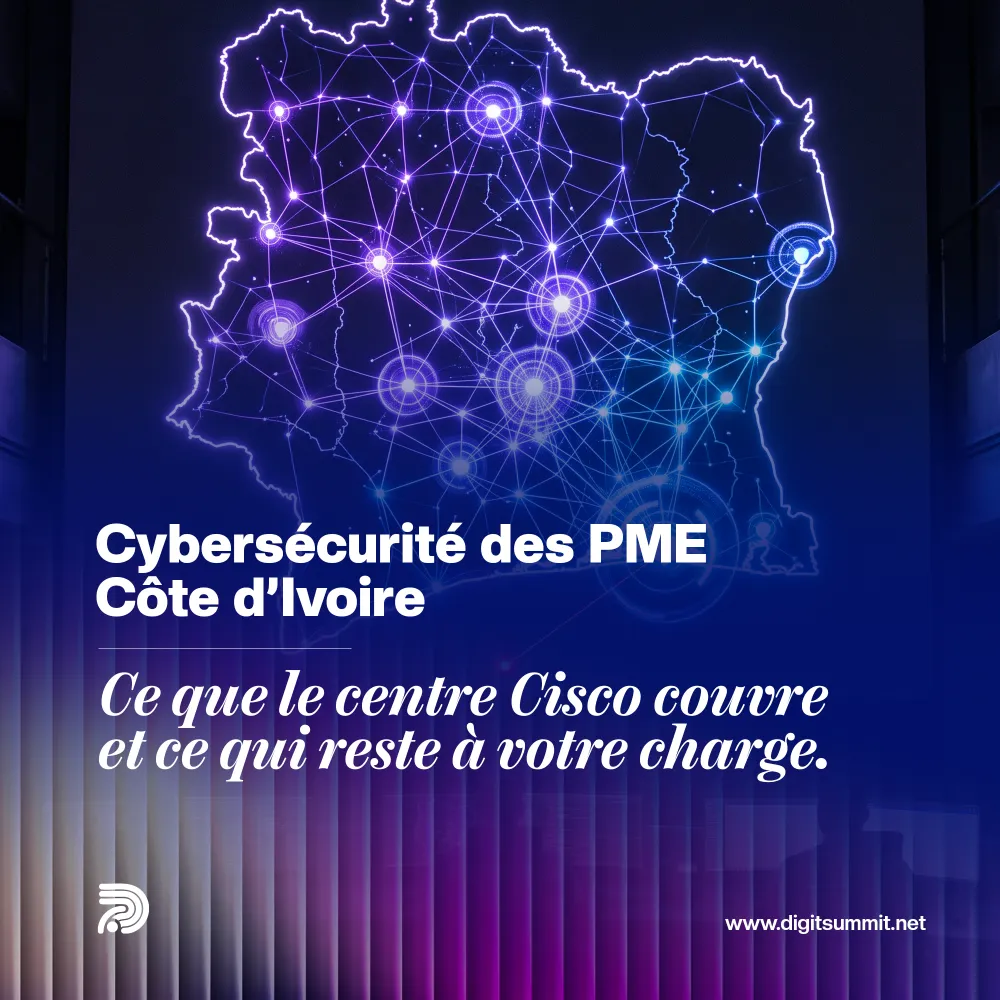
On Thursday 5 November, in Biétry, the Minister of Digital Transition and Technological Innovation, Djibril Ouattara, inaugurated Cybastion's Cisco cybersecurity centre (Digital Business Africa). The news spread widely, and more than one business leader thought: at last, someone is keeping watch. That is true. But that someone is not watching over your website, or your accountant's mailbox.
For SME cybersecurity in Côte d'Ivoire, this centre is good news at national level. It does not, however, change anything about what you need to do in your own business. Here is what it covers, what remains your responsibility, and a short list to apply before the end of the week.
What the Biétry centre does
The “Cisco Cybersecurity Center at Cybastion” is intended to serve as a regional hub to strengthen the preparedness and response of the Ivorian government and other African countries to cyber threats, according to the press release reported by Financial Afrik (Financial Afrik). It is managed and operated by Cybastion, an American technology company (Financial Afrik) (Digital Business Africa).
In practical terms, it combines two tools. First, a security operations centre, or SOC: a team of analysts who continuously monitor IT systems to detect attacks. Second, an incident response team, which handles incidents once they have been detected (Digital Business Africa).
The inauguration was also an opportunity to talk about training. The minister mentioned the Africa DigiEmpower programme, which plans to train 200,000 Ivorian learners in networking, cybersecurity and artificial intelligence by 2030 (AIP). Djibril Ouattara describes it as infrastructure of “strategic importance” for the country, and Digital Business Africa sees it first and foremost as good news for public administrations, which are sometimes targeted by attacks (Digital Business Africa).
Why your website is not under its watch
A SOC monitors the systems entrusted to it. The articles published so far describe a centre focused on the State and partner countries; none mentions any offer for SMEs (Financial Afrik) (Digital Business Africa). If such an offer does emerge, it will probably involve a contract, with a defined scope and a price.
Until then, nobody in Biétry will notice that a plugin on your WordPress site has not been updated for months. Nobody will receive an alert if your shop's home page is replaced by a hacker's on a Sunday evening. Nobody will restore your customer file.
The country's capabilities are improving, and that is useful: more specialists trained locally, more resources to respond to major attacks. But anyone targeting an SME rarely comes in through the front door. They look for the easiest weakness: a weak password, a forgotten piece of software, a backup that does not exist.
What Orange and Huawei are asking of businesses
On the same day, during a panel entitled “Digitalisation of digital services: what levers to accelerate securely”, executives from Orange Côte d'Ivoire and Huawei Côte d'Ivoire urged Ivorian companies to strengthen their cybersecurity and to build data protection into their digital solutions from the design stage (AIP).
Fitzgerald Bony, Deputy Director of Innovation, Artificial Intelligence and Digital at Orange Côte d'Ivoire, pointed out that the growth of digital usage, led by mobile money, increases the exposure of citizens and businesses to cyber threats (AIP). In other words: the more you sell and collect payments online, the more you have to protect.
“By design” means something simple. Security is not tacked on at the end, once the website is live. You decide at the outset what data you collect, where it is stored and who can access it, and you keep only what you need. A quote request form does not need the customer's date of birth.
This is not just good practice. In Côte d'Ivoire, Law No. 2013-450 of 19 June 2013 governs the protection of personal data, under the supervision of ARTCI, and most data processing must be declared to it in advance (BNTIC).
SME cybersecurity in Côte d'Ivoire: four tasks that remain yours
Updates
When a vendor releases a patch, the vulnerability it fixes becomes public. Until you have installed the update, your website remains open to anyone who has read about it. This applies to WordPress, to every plugin, to the theme and to the PHP version, the language that runs the site. We have covered two recent cases in detail: the vulnerability that strikes during the WordPress 7.1.4 update and the PHP version to check on your website.
Backups
A backup that has never been restored is a promise, not a backup. You need a recent copy, stored somewhere other than the website's server, and tested from time to time. If the server is hacked or the hosting provider goes down, that copy is what gets you back online.
Monitoring
The day your website goes down, who finds out first? Too often, it is a customer, on WhatsApp. A monitoring tool alerts you by e-mail or text message if the site stops responding, if a page changes or if a new administrator account appears. But someone still has to receive the alert and know what to do.
Data, by design
This is the advice from Orange and Huawei, applied at your scale. The less you collect, the less you risk losing. Every access must be tied to a named person: one account per person, never a password shared among five colleagues, and accounts belonging to former employees or contractors closed on the day they leave.
The checklist to apply this week
Set aside half a day with the person who manages your website. Here are the points to review:
- List everything that carries your name online: website, online shop, domain name, hosting, mailboxes, social media pages. For each one, note who holds the access credentials.
- Enable two-factor authentication (a code sent to your phone in addition to the password) on your e-mail, your hosting and your website administration.
- Delete unnecessary administrator accounts: a former intern, a former agency, a “test” account.
- Check the versions of WordPress, the plugins, the theme and PHP. Make a backup, then run the updates.
- Ask where your latest backup is stored and how old it is. Do a test restore on a copy of the site.
- Set up monitoring that alerts you if the site goes down.
- Review your forms and remove any fields that serve no purpose.
- Write down on a sheet of paper who to call in the event of an attack: your service provider, your hosting provider, and your bank if payments are affected.
If three of these points cause you problems, you know where the work begins. The Biétry centre strengthens the country; the door to your business, however, remains your responsibility.
If you prefer to delegate these tasks, our Web security & maintenance service handles updates, backups, monitoring and protection against hacking, starting with a free audit. You can also write to us to review your website.
Frequently asked questions
Can the Cisco cybersecurity centre in Abidjan protect my company’s website?
Not at this stage, according to published articles. The centre is presented as a hub designed to strengthen cyberthreat preparedness and response for the Ivorian government and other African countries. No source mentions any service open to SMEs: the security of your website remains your responsibility.
What is a SOC?
A SOC, or security operations centre, is a team that continuously monitors IT systems to detect attacks. It only monitors the systems entrusted to it, usually under contract.
What does protecting data by design mean?
It means thinking about security when you create a website or tool, not after it goes live. You decide from the start which data to collect, where to store it and who can access it, and you keep only what is useful.
Does an Ivorian SME have to declare its customer files?
Law No. 2013-450 of 19 June 2013 governs the protection of personal data in Côte d’Ivoire, under the supervision of ARTCI. Most data processing must be declared in advance. Check your situation with ARTCI or a legal adviser.
Where should I start if I only have half a day?
Enable two-factor authentication on your e-mail, your hosting and your website administration, then delete unnecessary administrator accounts. Next, check where your latest backup is stored and do a test restore.
Sources
- Financial Afrik, Côte d’Ivoire: Cybastion opens a regional cybersecurity centre in Abidjan built on Cisco technologies (4 November 2026)
- Digital Business Africa, Côte d’Ivoire: The strategic role of Cybastion’s new Cisco cybersecurity centre (6 November 2026)
- Digital Business Africa, Côte d’Ivoire: Cisco and Cybastion open a regional cybersecurity centre in Abidjan
- AIP, Côte d’Ivoire-AIP/ A Cisco cybersecurity centre opens in Abidjan to strengthen digital protection (6 November 2026)
- AIP, Côte d’Ivoire-AIP/Companies urged to anticipate the risks of digitalisation (6 November 2026)
- BNTIC, Data protection in Côte d’Ivoire: Law No. 2013-450, ARTCI
Was this article helpful?
Thank you! Your feedback helps us choose our next topics. Get the next articles