
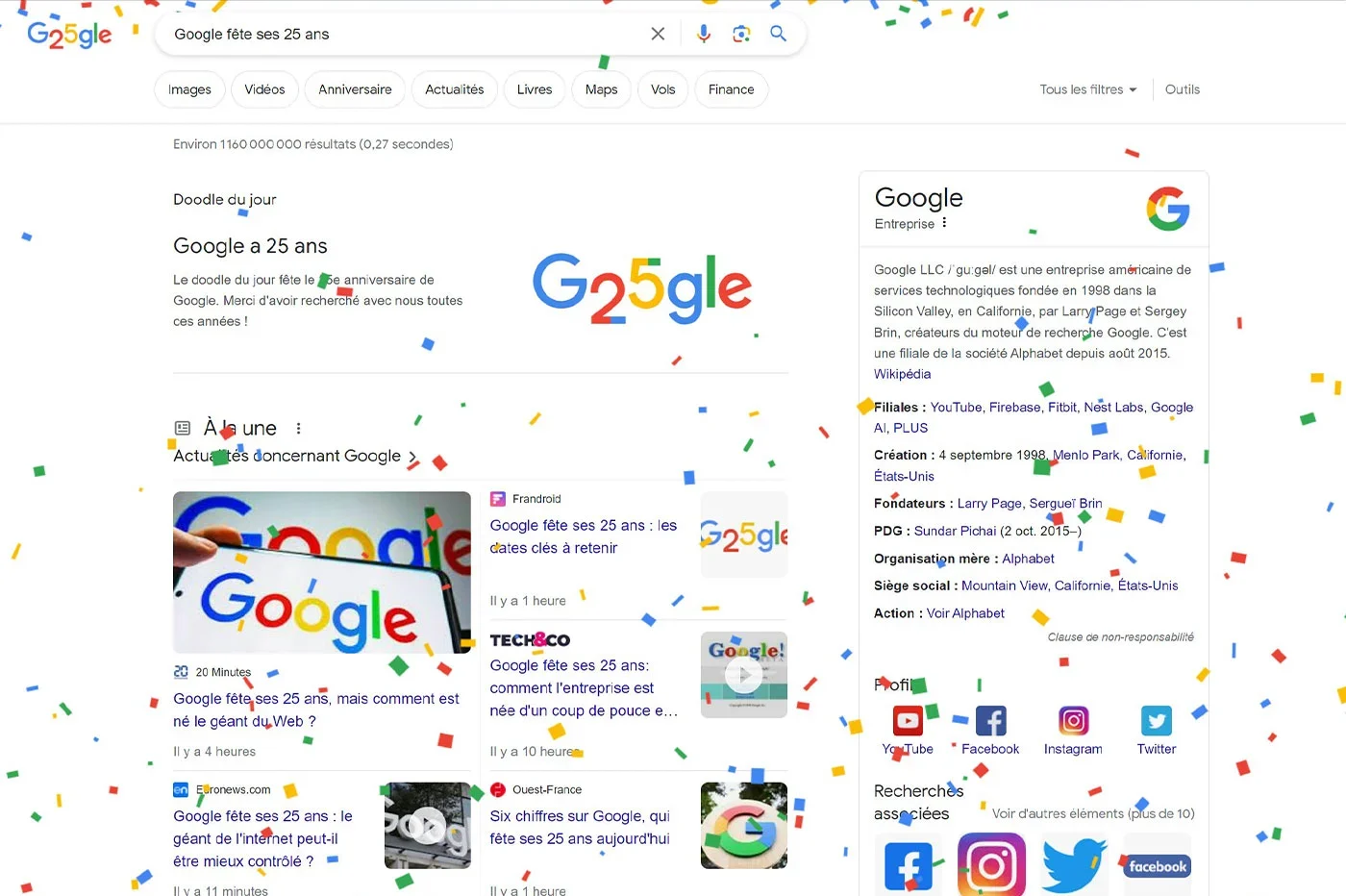
Since it was founded a quarter of a century ago, Google has become much more than just a technology company. It is a pillar of the digital age, an invaluable source of knowledge and a major player in technological innovation. Today, as we celebrate the 25th anniversary of this iconic company, it is time to look back and trace its incredible journey.
Google: much more than a tech company
Founded in 1998 by Larry Page and Sergey Brin, Google quickly revolutionised the way we search for information online. Its search engine, powered by the PageRank algorithm, paved the way for an era of fast, accurate online search accessible to everyone. Over the years, Google has extended its footprint far beyond search, investing in a wide range of technology fields, from online advertising to artificial intelligence and self-driving vehicles.
But Google is much more than a successful tech company. It has become a cultural icon, influencing the way we live, work and interact with the digital world around us. From inspiring Google Doodles to the Android operating system, Google permeates our daily lives in ways that are often subtle but profound.
This article invites you to dive into the fascinating history of Google, explore its crucial role in the digital revolution and reflect on its future in a constantly changing world. So get ready for a journey through 25 years of innovation and technological transformation at Google, a company that has shaped the modern digital landscape like no other.
Google’s beginnings
Google’s fascinating journey began modestly in a small university room at Stanford in 1998. It was there that Larry Page and Sergey Brin, two PhD students, set out to create a revolutionary search engine. Their vision was to catalogue and rank the vast amount of information available on the Internet more efficiently than ever before.
Their search engine was initially called “Backrub”, but it soon became “Google”, a name derived from the mathematical term “googol”, which represents a 1 followed by 100 zeros, reflecting the boundless ambition of their projects.
The key to Google’s success lay in its revolutionary algorithm, “PageRank”, which assessed the relevance of web pages based on the number and quality of links pointing to them. This enabled Google to deliver search results that were far more relevant than those of its competitors at the time.
In August 1996, Google reached a major milestone by launching its first public version. Users were quickly won over by the simplicity and efficiency of the search engine. Word of mouth spread fast, making Google a household name on the tech scene.
Innovation did not stop there. Google continued to refine its search algorithm, expand its index of web pages and offer new features such as image search. Within a short time, it became the search engine of choice for Internet users worldwide, sparking a revolution in the way we access information online.
Google’s modest beginnings as a university project thus laid the foundations for a company that would transform the technological and digital landscape in unimaginable ways. The rest of this article explores how Google has continued to evolve and innovate over its 25 years of existence.
The online search revolution
The creation of the Google search engine was not limited to simply searching for data online. It ushered in a revolution in the way individuals, businesses and even researchers access information on the Internet.
One of the cornerstones of this revolution was the introduction of the PageRank algorithm. Designed by Google’s founders, Larry Page and Sergey Brin, this algorithm introduced a radically new approach to ranking web pages by relevance. Instead of relying solely on keywords, PageRank assessed the quality and popularity of the links pointing to a given page. This enabled Google to deliver search results that were far more relevant than those of its competitors at the time.
Thanks to this innovation, Google quickly conquered the online search market. Users were impressed by the quality of the results they obtained, which led to mass adoption of the search engine. Soon, “to google” became a common verb, synonymous with fast, efficient online search.
The PageRank algorithm was only the beginning. Google continued to improve its search algorithms over the years, introducing major updates such as Panda, Penguin and Hummingbird. These updates aimed to combat low-quality content, improve the relevance of results and better understand user intent.
Google also steadily expanded its search index to include billions of web pages, local information and even real-time results. Features such as image search, Google News and Google Scholar broadened the search engine’s usefulness, turning it into an invaluable resource for students, researchers and professionals in a variety of fields.
Google: much more than a search engine
While Google was revolutionising online search, the company did not rest on its laurels. It quickly diversified into new technology fields, redefining its role in the digital world.
One of the first important steps in this diversification was the launch of Google AdWords in 2000, a revolutionary online advertising system. AdWords enabled advertisers to target their audience precisely based on search keywords, paving the way for a viable business model for free online services. This advertising-based model contributed to Google’s rapid growth and its rise as a tech giant.
But Google did not stop there. The company also began acquiring innovative companies to expand its technological footprint. In 2006, Google acquired YouTube, the online video-sharing platform, which has become a staple of Internet culture. In 2005, Google bought Android, laying the foundations for its mobile operating system, which is now used by billions of smartphones worldwide.
However, one of Google’s most significant acquisitions was DeepMind, a company specialising in artificial intelligence, in 2014. This acquisition strengthened Google’s position in AI and led to the development of impressive projects such as AlphaGo, an AI program that beat the world Go champion, marking a major milestone in the field of AI.
As Google extended its presence across various technology fields, the company continued to innovate with products and services such as Google Maps, Google Docs and, of course, the Android operating system. These products helped strengthen Google’s presence in people’s daily lives, whether for finding a route, collaborating on documents online or using mobile apps.
Google thus went from being a simple search engine to a diversified, multifaceted company, playing a key role in many aspects of modern digital life. The next section of this article explores how Google has left an indelible mark on digital culture and become a symbol of innovation and entrepreneurship.
Google’s contribution to digital culture
Beyond its technological innovations, Google has had a profound influence on global digital culture. The company has become much more than just a player in the tech sector; it has become a symbol of innovation, expertise and creativity.
One of Google’s most visible contributions to digital culture is undoubtedly the “Google Doodles”. These artistic variations of the Google logo, created to celebrate special events, birthdays of famous people or historic dates, have become an online tradition since their introduction in 1998. Google Doodles are not only a source of artistic inspiration, but also a reminder of the importance of celebrating cultural diversity and key moments in history.
Google has also played a major role in democratising knowledge. With Google Books, the company embarked on an ambitious project to digitise millions of books from around the world and make them accessible. This initiative has given readers, researchers and students access to a wealth of knowledge that was once out of reach.
The company has also built innovation into its corporate culture, encouraging employees to devote time to personal projects, which gave rise to products and services such as Gmail and Google News. This culture of innovation has inspired many other companies to adopt similar practices, helping to energise the tech sector.
Finally, Google has become an integral part of the daily lives of many people around the world. Its Android operating system is used by billions of smartphones, and Google Maps has become an essential tool for navigation and finding places. In addition, Google services such as YouTube, Gmail and Google Drive have become staples of online communication and productivity.
Current and future challenges
As it approaches its 25th anniversary, Google faces a series of challenges and opportunities that will shape its future and its place in the constantly evolving world of technology.
One of the most pressing challenges Google faces is privacy protection and antitrust regulation. As a company that holds a considerable share of the online advertising market and collects massive amounts of personal data, Google is under scrutiny from regulators around the world. Concerns about user privacy and anti-competitive practices are major issues that require appropriate responses from the company.
Google has also committed to sustainability initiatives. The company has announced its goal of running all of its global operations on clean energy 24 hours a day, 7 days a week, by 2030. Google has also invested in renewable energy projects and has committed to offsetting its entire carbon footprint dating back to its founding in 1998. These efforts reflect a growing awareness of the importance of sustainability in the technology sector.
Looking ahead, Google continues to position itself as a major player in artificial intelligence (AI). Products such as TensorFlow, an open-source machine learning platform, and Google Assistant, an AI-powered virtual assistant, show that Google remains at the forefront of AI research. AI has a wide range of applications, from speech recognition to autonomous driving, and Google is determined to be a leader in these fields.
Cloud computing is another area of strategic expansion for Google. Google Cloud, the company’s cloud division, competes actively with Amazon Web Services (AWS) and Microsoft Azure for enterprise customers. Cloud computing services are becoming increasingly essential as businesses move their operations to the cloud, which makes this competition both a major challenge and a major opportunity for Google.
Google in the age of artificial intelligence
Artificial intelligence (AI) is one of the most powerful driving forces of technological innovation in the 21st century, and Google has established itself as a key player in this revolution.
Google has invested heavily in AI development, with impressive results. One of its most iconic projects is TensorFlow, an open-source machine learning library. TensorFlow has become an essential tool for researchers and engineers around the world, enabling them to build powerful, customised AI models.
A striking example of the power of AI at Google is Google Assistant. Powered by advanced machine learning technologies, Google Assistant is a virtual assistant that can understand and respond to natural voice commands. It can perform a wide range of tasks, from managing your calendar and searching for information on the web to controlling connected home devices. This technological advance has transformed the way we interact with our digital devices.
Google has also invested in autonomous driving. Its subsidiary Waymo has been developing self-driving technologies for several years and has deployed fleets of autonomous vehicles in certain regions. This initiative aims to revolutionise the automotive industry by using AI to make driving safer and more efficient.
However, the rise of AI comes with its share of challenges. Google, like other technology companies, must deal with complex questions related to AI ethics, data security and algorithmic transparency. These challenges are at the heart of discussions about the role of AI in our society and how it should be regulated.
Despite these challenges, Google continues to invest in AI and to push the boundaries of what is possible. The company is determined to use AI to solve complex problems, whether in medical research, climate data analysis or improving business productivity.
25 years of innovation: key dates
- 1999: Google moves into its first office in Palo Alto, California.
- 7 February 2000: Google launches AdWords, a revolutionary advertising product, with 350 customers.
- 2001: Eric Schmidt becomes CEO of Google, a position he will hold until 2011.
- 2004: Google introduces Gmail, its e-mail service.
- 19 August 2004: Google goes public with an initial public offering (IPO) at $85 per share.
- 2005: Google Maps is launched, revolutionising online navigation and mapping.
- 2006: Google acquires YouTube, the video-sharing platform, for $1.65 billion.
- 2007: Google unveils its Android mobile operating system.
- 1 September 2008: Google launches Chrome, its web browser.
- 2008: Google introduces the first Android phone, the T-Mobile G1.
- 2011: Larry Page becomes CEO of Google again.
- 2012: Google introduces Google Drive, a cloud storage service.
- 2013: Google launches Google Glass, an innovative venture into augmented reality.
- 2015: The company is restructured and Alphabet Inc. becomes Google’s parent company.
- 2016: Google launches Google Assistant, a virtual assistant powered by artificial intelligence.
- 2017: Google Drive reaches 1 billion monthly active users.
- 2018: Google receives a record $5 billion fine from the European Union for abusing its dominant position with Android.
- 2019: Sundar Pichai becomes CEO of Alphabet Inc., having been CEO of Google since 2015.
- 2021: Google announces numerous advances in artificial intelligence, particularly in medical research.
- 2022: The self-driving technology of Waymo, a subsidiary of Alphabet Inc., continues to advance.
- 2023: Google celebrates 25 years of innovation and technological transformation.
Was this article helpful?
Thank you! Your feedback helps us choose our next topics. Get the next articles